Previous ASME Award Winner

Capstone Design Projects

Temperature Control of Rugged 3D Printer

2020-2021 - Spring

Team: 2

Team Members

Eric Shnell
Duo Xu
Juan Gutierrez
Myriam Lopez
Elvin Lin

Contact Team
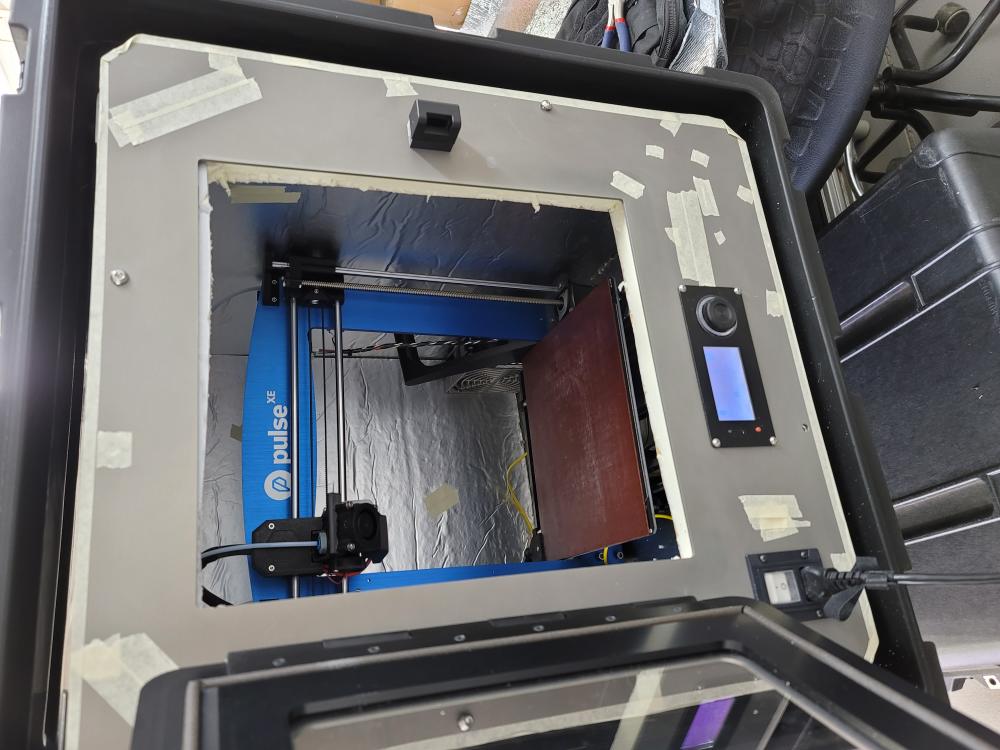
Temperature control system for a rugged 3D printer. The system is designed to heat printing chamber to 50°C and maintain that temperature regardless of external conditions. The system is resistant to shocks and vibrations and can operate between -15°C and 50°C ambient temperature.
Integrated temperature control system with 3D printer in aluminum case

Bike Helmet Task Light

2020-2021 - Spring

Team: 15

Team Members

Skyla Bertsch
Eric Fong
Kent Pinz
Simon Valenzuela
Melvin Vo

Contact Team
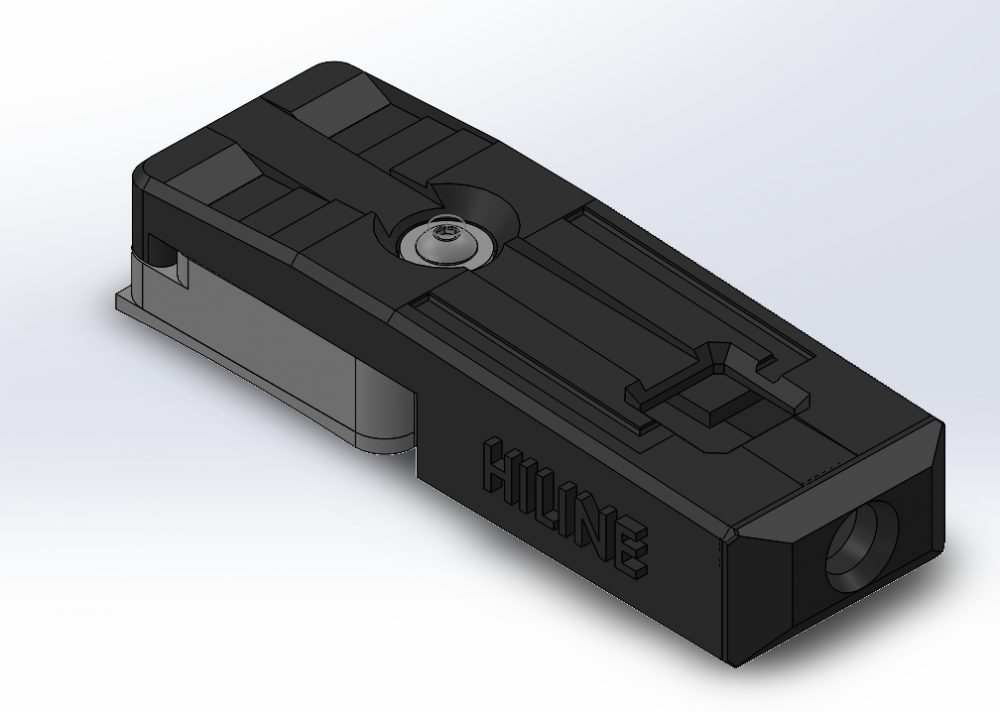
This bike helmet task light is meant to facilitate field repairs, adjustments, or other needs for close-range illumination while riding in nighttime, twilight, or other low-light conditions. This project is compact, lightweight, has a low-profile housing, and utilizes a universal mounting mechanism which allows the light housing to be removed to recharge its battery. It is durable for shock, vibration, and other rugged mountain biking conditions.
Bike Helmet Task Light

Automated Solubility Measurement

2020-2021 - Spring

Team: 25

Team Members

Owen Cruise
Yaxin (Cindy) Guan
Kristin Hartsfield
Brandon Lansang
Cade Wohltman
Contact Team
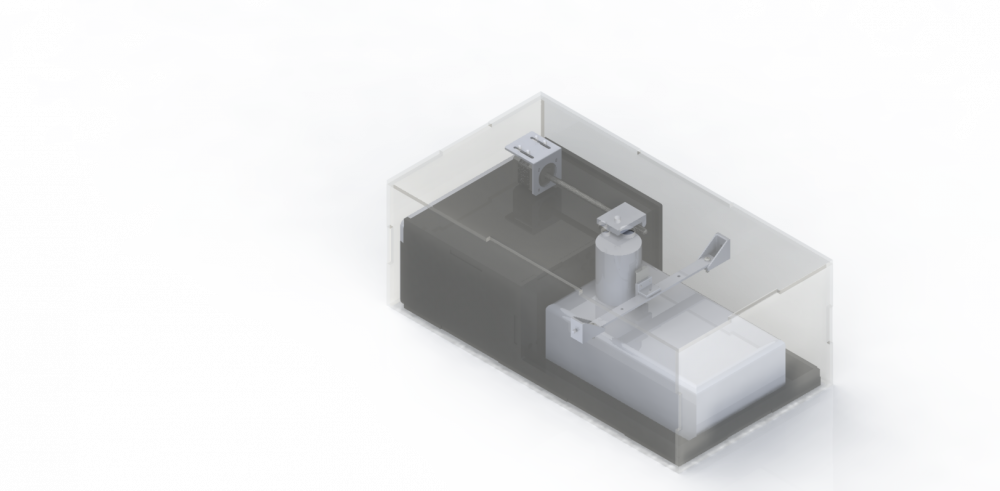
This device automates the process of mixing a solute in a solvent to reach its saturation point. It includes solid dosing and liquid dosing capabilities; light scattering analyzes turbidity and settled solids, reducing the human burden of a common lab experiment.
SolidWorks render (isometric view) of the automated solubility project experiment.  The main shape is a rectangular prism.  Inside, a magnetic stirrer sits in the lower portion, with a beaker resting on top of it.  Mounted to the lid of the box is a horizontal rod which holds an RGB sensor.  A motor driver is positioned over the top of the beaker, along with three holes.

Wearable Lower Body Negative Pressure Pump

2020-2021 - Spring

Team: 23

Team Members

Cindy Alberto
Natalie Gilvaja
Sidney Huen
Brendan Justus
Eni Ikuku

Contact Team
Currently, the constant exposure of astronauts to microgravity in space has the potential to cause lasting negative effects on the human body, which include muscular atrophy and even some cardiovascular deconditioning. To combat this, a mobile wearable circulation pump was designed to simulate gravity by creating a negative pressure of 20 mmHg within the suit and reverting fluid shifts in the body.
Complete Set Up of Vacuum Wiring

Brain Organoid Advanced Research Development in Space (BOARDS) Launch Acceleration Simulation Tool

2020-2021 - Spring

Team: 14

Team Members

Christian Chan
David Morales
Jerry Lai
Junsong Kim
Mary Nguyen

Contact Team
The pursuit of space as the next frontier of human exploration raises the question of how space microgravity affects the human brain. To study these effects, brain samples will be sent to the International Space Station aboard a Falcon 9 rocket. However, the high G-forces of a rocket launch may damage the samples. As a result, an acceleration centrifuge simulator was designed to simulate a rocket launch profile to account for these high G-forces.
BLAST centrifuge assembly that will be build and tested at The Arthur C. Clarke Center for Human Imagination.

Optimization of COVID-19 Testing Workflow

2020-2021 - Spring

Team: 6
Team Members

Sidney Chan
Miya Coimbra
Garrett Dawson
Matthew Lok
Haoyi Tian

Contact Team
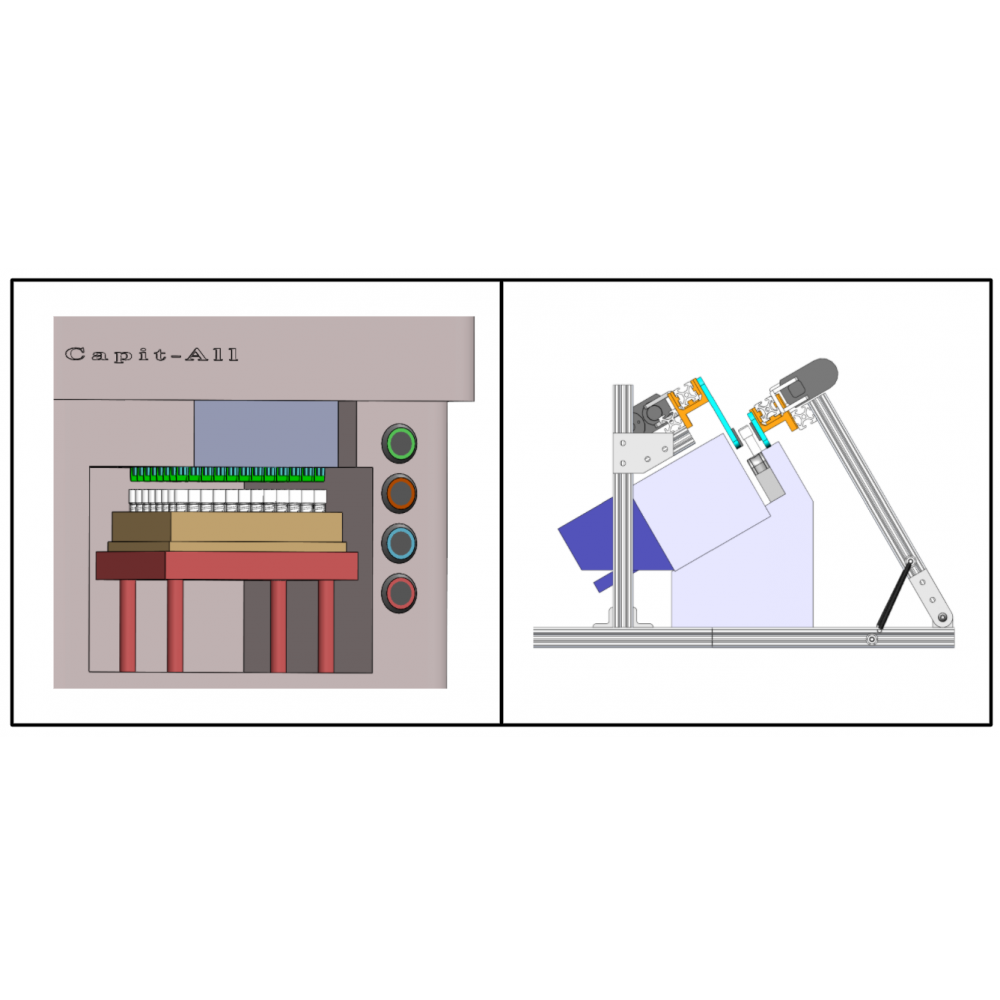
This project provided two solutions for automating the decapping of COVID-19 sample test tubes in UC San Diego's EXCITE Lab. The goal of the project was to increase overall testing throughput by decreasing decapping time and circumventing limitations on certain equipment.
Left image: Adapters for the Capit-All machine to aid in decapping 1-1.4 mL tubes. Right image: The Parallel Beam Decapper, which decaps 5 mL tubes.

ATA Smart Animatronic Figure Breakaway Joint

2020-2021 - Spring

Team: 1

Team Members

Vi Ly
Xuebin Zhu
Ze Zhuang
Matthew Henry
Devanshu (Dev) Gulati

Contact Team
The primary goal of the project is to refine the functionality of an animatronic figure that ATA will use to enhance their analytical design, robotics, and controls capabilities. The project involves: (1) designing and implementing a breakaway mechanism at the upper arm segment of the animatronic figure, (2) creating a dynamic model that predicts arm breakaway under different motion profiles, and (3) developing a control strategy that safely operates the arm in the event of a breakaway.
Our animatronic figure waving hi!

Bicycle Theft Detection

2020-2021 - Spring

Team: 22
Team Members

Nozomu Harada
Jared Benge
Alex Betancur
Bennet Wells
Boruch Allison

Contact Team
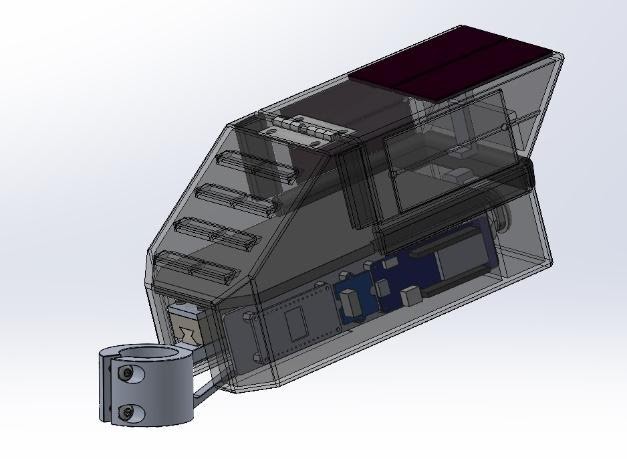
Our device, which can be attached nicely underneath a saddle like a saddlebag, is capable of sensing movement of a bike and sending an alert to the user via text messages. To achieve long operation period, the device is equipped with four solar panels which are capable of not only running the system but charging the battery whenever possible.
The image shows our device with electronic components inside being visible.

Endotracheal Tube Support System

2020-2021 - Spring

Team: 7
Team Members

Shanlin Chen
Rufu Gong
James Knights
Dylan Haselton

Contact Team
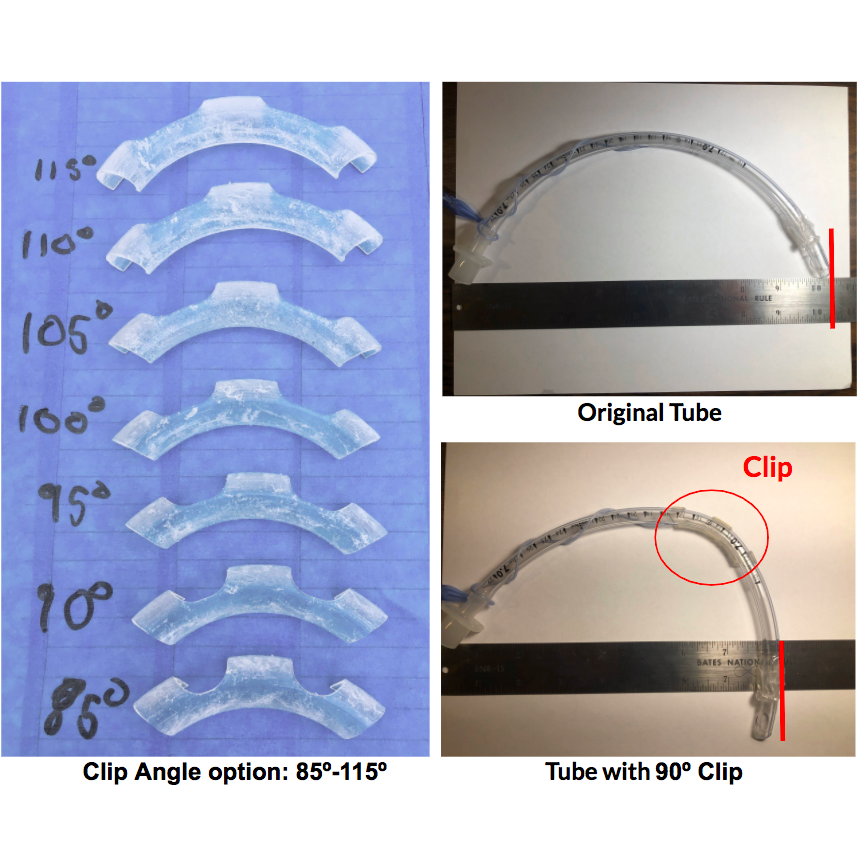
The purpose of the endotracheal tube support system is to reduce the pressure placed on the posterior larynx by the endotracheal tube during the length of the intubation period. Our team developed a sleek, strong, and durable clip which, once applied, guides the endotracheal tube to bend away from the posterior larynx therefore decreasing the chance of the patient’s voice box being permanently injured while intubated.
Elbow clip design with various angles and an example of 90-degree clip application.

Solar Turbines Alignment Mechanism

2020-2021 - Spring

Team: 5

Team Members

Nigel Coseip
Alberto Guardado
Vicente Lopez-Espinosa
Daniel Lopez Villa
Nicholas Pereyda

Contact Team
The purpose of this project was to investigate a new mounting foot design for a Solar Turbines Titan-250 turbine. Our solution would need to incorporate an actuation method which can produce precise movement, and a locking mechanism capable of arresting the feet under all conditions. The team identified two actuation solutions: a set of jacking bolts, and a worm gear screw jack. Both designs have their own advantages such as cost, maintenance, and ease of operation.
A view of the Jacking Bolt and Worm Gear solutions

General Atomics: Robotic Handling

2020-2021 - Spring

Team: 13

Team Members

Janette Juarez
Isaac Kiah
Cris Madla
Erik Sanchez
Ryan Wong

Contact Team
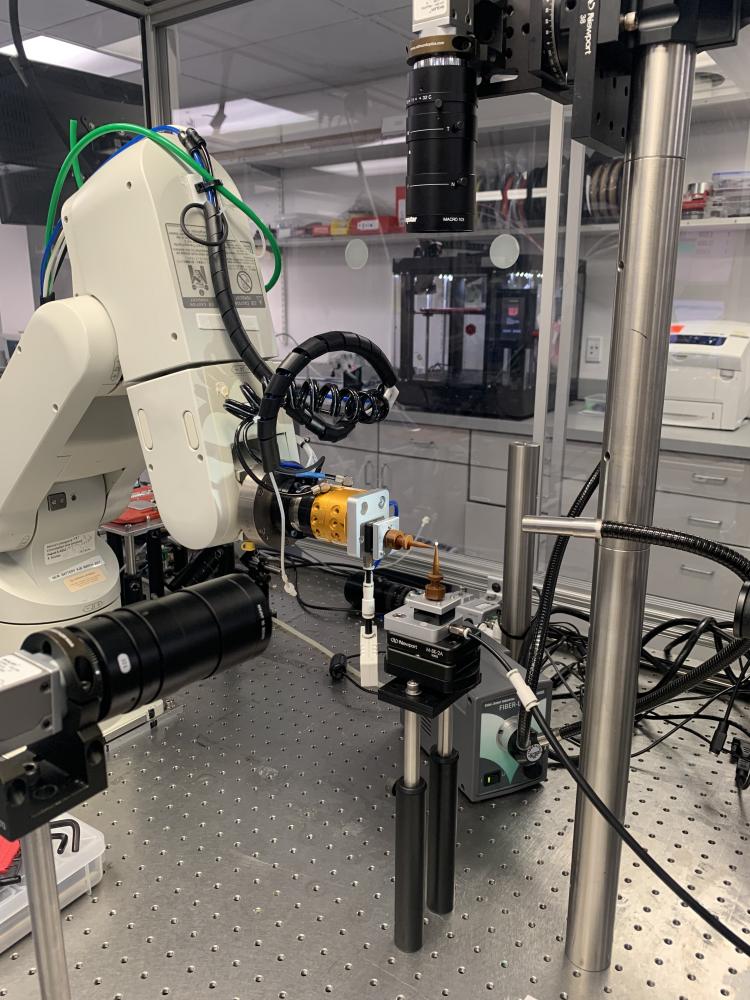
This project analyzes the quality control of very small spherical capsules that are used to hold gases in a process called Inertial Confinement Fusion (ICF). The surface roughness and sphericity of the capsules affect the ICF process so they must be mapped using an atomic force microscope. General Atomics uses a robotic arm to re-orient the capsule to map the entire surface. The reorientation process has been found to contribute ~3° of rotational error which this project investigates.
Workstation setup where robotic arm picks up a 2mm capsule, reorients it, and places it back down.

Development of Advanced Hose Clamp

2020-2021 - Spring

Team: 18

Team Members

Tyler Arlan
Tate Castillo
Fateh Sandhu
Diego Tocol
Kyle Venstrom

Contact Team
This project focuses on the development of a new hose clamp to be used in Wildland firefighting to stop the high-pressure flow in a fire hose to attach more hoses. The project achieved this goal through testing and modeling the hose used by firefighters to get a better understanding of the force needed to restrict the flow of water. The team designed, analyzed and prototyped a newer hose clamp. This clamp will be less expensive, durable, and easier to use than existing hose clamp models.
Clamping Bar used to stop water flow in a fire hose

Automated Washing System

2004-2005 - Spring

Team: 7

Team Members

Arash Khalifeh
Dan Miller
Darmawan Setiawan
Parminder Ubhi

Ink Cartridge Test-Bed

2004-2005 - Winter

Team: 8

Team Members

Kevin Loewke
John McCague
Linda Hau
Kuroudo Iwanaga

SUV Rack System

2004-2005 - Winter

Team: 7

Team Members

Chad Fondiller
Ukoh Obot
Tyler Mayer
Eric Lin

LADAR Isolation Mount

2004-2005 - Winter

Team: 6

Team Members

Chris Choi
Kyung Park
Steve Geist
Rick Sozzi
Annie Monkowski

RoboPogo the Hopping Robot

2004-2005 - Winter

Team: 5

Team Members

John Bell
Jenny Dyck
Isad Cimanes
Ying Lang Lao
Andrew Marshall

Rotational IR Sensor Array

2004-2005 - Winter

Team: 4

Team Members

Michelle Darley
Sam Hutsell
Ben Penney
Brent Rust
Thomas Sarmiento

Thermoelectric Power Supply

2004-2005 - Winter

Team: 3

Team Members

Jeff Aller
Sarah Au
Katie Bottum
Rick Harrison
Alex Zimmerman

Muscle Fiber Fixture

2004-2005 - Winter

Team: 2

Team Members

Mashia Ghods
Elaine Karaelias
Nelson Bravo
Dustin Wong

Thermal Interface Fixture

2004-2005 - Winter

Team: 1

Team Members

David Allen
Rosalyn Esteves
Lucas Fornace
Jon Hart
Raquel Timmer-Beck

Toy Adapter

2004-2005 - Spring

Team: 14

Team Members

Edsel Villar
Hung Ma
John Haesle
Kenan Juntsal

Foot Joystick Mouse

2004-2005 - Spring

Team: 13

Team Members

Andy Barbour
Eric Kim
Dominic Ghianni

Pheromone Releaser

2004-2005 - Spring

Team: 8

Team Members

Tyler Bettendorf
Ainsley Chiang
Kazu Otani
Lowell Tejada

Harddisk Drop Tester

2004-2005 - Spring

Team: 5

Team Members

Khanh Le
Ken Chen
Oscar Guerrero
Amorsolo Lacanilao

Film Cutting Automation

2004-2005 - Spring

Team: 4

Team Members

Daniel Arnold
Jonathan Costabile
Matthew Oliphant
Brian Uiga

Cultivator Implement

2004-2005 - Spring

Team: 3

Team Members

Anthony Kralj
Zaid Karim
Stephen Perez
Jack Raley

Scanner Analyzer

2004-2005 - Spring

Team: 6

Team Members

Linda Galaviz
Ka Lok Lui
Ronald Roath
Nicholas Tawa

Surface Force Macroscope

2004-2005 - Spring

Team: 2

Team Members

Jeremy Sorensen
Adam Rusch
Raymond Hsu

Spine Tester

2004-2005 - Spring

Team: 1

Team Members

Chris Hohn
Nick Statom
Ed Lachman
Omar Amin